

How They Track You: Email Service Provider Edition
What'south the all-time gratuitous email service provider that does not scan or apply the data in your emails for advertising? Jim
Gratuitous email services are commonly paid for by showing you advertisements. Some email services browse your emails in gild to show you personalised or targeted ads. You could argue that that's a benefit, because you'll see ads in which yous might accept some interest. You lot could too argue that your emails are individual, and then information technology's an invasion of privacy. Either fashion, it's different from scanning your emails to terminate viruses and phishing attempts, which nobody wants to stop.
In that location are several options, just the problem is bigger than you may think, and likely to go worse.
Gmail and AI
When Google launched Gmail in 2004, information technology did indeed scan your emails for advertising purposes. You could just avoid it by using a paid-for version of the service. That changed last summer, when Google announced that it would no longer scan emails to tailor adverts.
That didn't hateful yous would become adverts picked at random. Every bit Alex Hern explained hither, "the adverts volition at present be targeted in the aforementioned way equally other Google services, based on information gleaned from other action on users' profiles, such every bit their searches, browsing activity, and fifty-fifty physical locations".
Google has the world'southward largest known tracking system, thanks partly to Google Analytics – which is used on far more websites than any Facebook tracker – and its DoubleClick advertising business. Add Google Search and it already knows so much about y'all that scanning your emails may well be superfluous. The good news is that you can delete a lot of information technology, with the help of a Guardian article by Dylan Curran: Here is all the information Facebook and Google have on you.
The problem is that Google has lots of other reasons to read your electronic mail, and you may find some of them useful. For instance, Google might tell you lot about traffic jams or flight delays, put appointments in your calendar, or offer to write quick email replies for yous. These features involve AI software reading your emails, tracking your website visits, and your location. In the future, it may include information from home speakers (Google Home etc), household gadgets (Nest etc), fitness bands, smartwatches, cars (Waymo) and other connected devices.
As AI gets smarter, there will exist more than and more opportunities for companies to track you, profile yous, and help you.
In other words, scanning emails to tailor advertisement is a relatively minor issue in the neat scheme of things. The larger problem is that the whole web economy is based on surveillance, and there's very little you can actually do about it. Even if yous effort to stay anonymous and cake cookies, you might be identified by techniques such as device profiling, fingerprinting, and AI systems that can recognise your typing.
Change email service
Neither of the 2 largest email services – Google's Gmail and Microsoft'south Outlook.com – scans your emails for advertizement purposes. If y'all desire to avoid those, Zoho Postal service is a good alternative. Information technology's primarily aimed at business users, and includes an online office suite and other features. It offers a free service with 5GB of mail storage space, so you can try it. You lot may detect it'southward worth paying €24 per year for 30GB of storage and other features such as domain aliases and Microsoft Active Sync support.
ProtonMail, which is based in Switzerland, is ane of the most privacy-conscious email services, and offers encrypted and self-destructing emails. All the same, information technology only provides 500MB of storage to not-paying users. ProtonMail Plus costs €48 per yr for 5GB of storage, while ProtonMail Visionary costs €288 per year for 20GB. You lot'd be more likely to utilise this as a supplementary service than for all your emails.
FastMail is a popular alternative, because it offers good support with no ads and no tracking, but information technology's not free. The Basic service with 2GB of storage costs $30 per year, while 25GB costs $50 and 100GB costs $90 per yr. There'southward a xxx-day free trial so you can test information technology first, and a migration guide to help you switch from some other supplier.
Utilise an email client
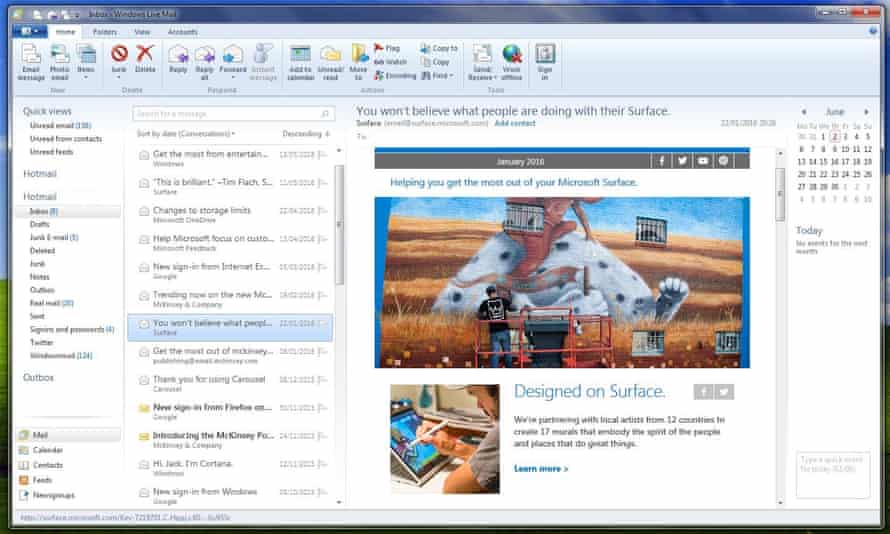
Well-nigh people now access their electronic mail service via a web browser. The pre-spider web alternative was to employ an email client programme to download new emails to your PC. If you use an electronic mail customer and so you won't see whatsoever targeted adverts even if your emails are scanned.
In the old days, email programs used POP3, the Mail service Office Protocol. The software downloaded your emails and so deleted them from the mail server. This has mostly been replaced by IMAP (Internet Message Access Protocol), which downloads emails and leaves them on the server, unless you delete them deliberately. This means you lot can download the same emails to several PCs, or read them online with a different smartphone, tablet or PC, etc.
E-mail programs take fallen on relatively hard times, and Microsoft has discontinued the Windows Live Mail plan that was popular with Ask Jack readers, (although it even so works). This is partly considering devices may already include a mail app, and the Mail and Calendar app in Windows 10 is actually pretty good for nigh users. Information technology supports multiple accounts, not just Outlook.com, and there are companion Outlook apps for Android and Apple smartphones.
Alternatives include Mozilla's free and open up source Thunderbird, which runs on Windows, MacOS and Linux, and Windows programs such as Mailbird and eM Client. Mailbird Low-cal is costless but y'all tin can get Mailbird Pro for $39 (or $nineteen.fifty at the time of writing). eM Client is gratis for non-commercial use but there'south a Pro version for £35.94.
Business users tend to use Microsoft Outlook, which is one of the principal Part programs. Outlook is not included in the Home and Pupil edition, only you could pick up a cheap version of Function 2016 Professional. Alternatively, you could subscribe to Office 365 Personal (£/$59.99 per yr for one user), or Office 365 Dwelling house (£/$79.99 per year for five users), and download information technology. Each Office 365 user gets 1TB of storage, which makes it economical.
Other controls
The online advertising industry has a cocky-regulatory trunk called the Digital Advertising Alliance (DAA), which offers advice to consumers. There's also the Network Advertising Initiative (NAI), a non-profit system that describes itself as "the leading self-regulatory clan dedicated to responsible data collection and its use for digital advertising".
The NAI has an "opt out" page, which sets an opt-out cookie that volition be respected past NAI members. You will withal meet ads, only most will not be targeted ads. It offered me the chance to opt out of targeted ads from 90 members, including Google, Microsoft and Yahoo. Yous have to run it in every browser you use.
You can as well install the EFF's Privacy Annoy and/or the open source Ghostery browser add together-on. Privacy Annoy tries to enforce Do Not Track if you lot have that turned on in your browser.
Another idea is to use Firefox'due south outset-party isolation (FPI) feature, which Mozilla has adopted from the Tor browser. To turn information technology on, paste the following into the address bar and set the elevation preference to True:
nigh:config?filter=privacy.firstparty.isolate
This may create log-in bug then it's improve to use an extension instead.
A more applied idea, currently, is to utilize a Firefox container to isolate a particular site. Mozilla offers a Facebook Container extension, which makes it easy. The total Multi-Account Containers extension lets yous go on any site – or group of sites – separate. It was designed to permit you, for example, log into two or more dissimilar accounts on one service in the aforementioned browser at the aforementioned time. However, yous could use a container to isolate Gmail or whatsoever other service.
Have you got a question? Electronic mail it to Ask.Jack@theguardian.com

How They Track You: Email Service Provider Edition,
Source: https://www.theguardian.com/technology/askjack/2018/apr/19/whats-the-best-email-service-that-doesnt-scan-emails-for-ad-targeting
Posted by: bennettandenderew.blogspot.com
0 Response to "How They Track You: Email Service Provider Edition"
Post a Comment