

How To Calculate Velocity At The Bottom Of A Ramp
Inclined Plane Calculator
Created by Wojciech Sas , PhD
Reviewed by
Bogna Szyk and Steven Wooding
Final updated:
Dec 21, 2022
This inclined airplane calculator is a tool that helps you solve issues about an inclined plane with the friction coefficient taken into consideration. Read on to find the inclined plane definition and mutual computational inclined plane examples.
What is an inclined plane?
An inclined plane can exist described every bit a flat surface that is lifted at ane side to grade an angle θ with the ground. You can observe the examples of inclined planes in everyday life, such every bit ramps or door wedges. A funicular is a blazon of send vehicle that also uses the concept of the inclined plane. The thought behind the simplicity and usefulness of the inclined plane is to reduce the force required to lift a body to some summit.
An inclined aeroplane is one of the virtually mutual unproblematic machines, together with the lever. Observe the latter at our lever calculator!
Bones parameters of the inclined plane
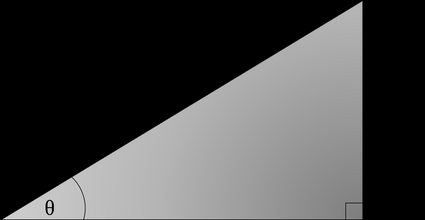
There are a few characteristics that tin adequately describe a simple inclined plane. The primary ane is the gradient associated with the already mentioned angle θ. The side by side ones are height (H) which is the maximal level above the basis, and length (Fifty) – the distance between the apex and the vertex at the angle θ. The side view of an inclined plane can be presented as a correct triangle, then you can hands observe a relationship between H, L, and θ if needed.
Friction coefficient is another feature of the inclined plane, and it denotes the being of a braking force that affects the trunk in motion or prevents the object from moving at all.
Inclined plane formulas for a cubic block
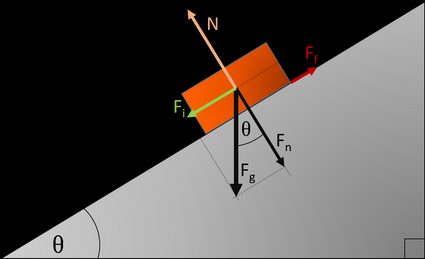
While working out problems of this type, it is always worth finding forces which act on our body:
-
Gravitational force: , where is the mass of object and is the gravitational abiding. It can exist divided into two components:
- – parallel to inclined plane; and
- – perpendicular one.
-
Strength of friction which works in the opposite direction every bit , simply depends on the value of normal force and friction coefficient :
-
At that place is also ground reaction force with the same value as and the reverse direction, only information technology doesn't take any influence on further calculations
The resultant force along the inclined plane can be worked out as a difference between and and thus rewritten equally:
1 important annotation: the above expression of the net force is only valid if the bending of the inclined airplane is not greater than the angle of friction , which can be estimated equally . Otherwise, the friction force compensates , and the object stays at rest.
With the known expression of the resultant forcefulness, it is a piece of cake to observe dispatch , sliding fourth dimension , and concluding velocity , using formulas from the dispatch calculator and the value of initial velocity :
If the object starts moving without initial velocity, the expression for sliding time simplifies to:
Rotary solids on an inclined aeroplane
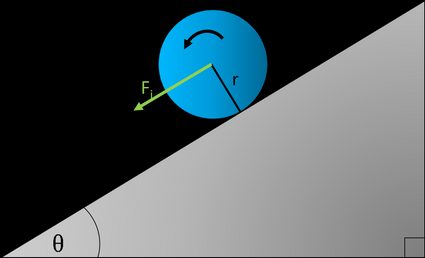
It isn't difficult to imagine some round object which would rather curl down instead of sliding. Therefore, a different approach has to exist adopted for rotary bodies. This time friction prevents objects from slippage and simultaneously allows rotation. We can echo the computing procedure from the previous section, taking into account both progressive and circular motions, which is quite catchy. Still, on the other hand, we tin can use the conservation of free energy.
It tells us that the sum of initial potential and kinetic energies equals the terminal kinetic energy. It's essential to remember that rotational kinetic energy is fixed in total kinetic energy. The acceleration formula changes every bit follows:
where is the object's moment of inertia and is the radius between the axis of rotation and the surface of the inclined aeroplane, which is usually equivalent to the body's radius (e.g., ball or cylinder). The remaining expressions for rolling time and last velocity are precisely the same as previously.
If yous're wondering how we arrived at this equation, make sure to read up on the potential energy formula.
💡 Calculate the forcefulness of a linear actuator on an inclined aeroplane with our linear actuator strength computer.
Cubic block – several computational examples
Example 1
Let'due south assume that we need to observe the sliding time and the final velocity of a sliding object with these input data: , , , , . You can obtain the solution with the following steps:
- Summate the gravitational force:
- Divide information technology into ii perpendicular components:
- Determine the friction force:
- Subtract F and to piece of work out the resultant force:
- Thus, acceleration tin can exist derived:
- The length of the inclined airplane equals:
- So the sliding fourth dimension can be obtained:
and as well the last velocity:
We can also gauge the energy loss, which is the difference betwixt the initial potential free energy and the terminal kinetic ane:
The total free energy isn't conserved, which is caused by the work done by the friction force. It's usually released in the course of heat.
Example two
In the 2nd example, permit'south detect the same parameter, but with different values of input information: , , , , .
Firstly, we tin can work out the angle of friction for a given friction coefficient:
...which is greater than our angle .
It means that the body won't motility due to sufficiently high friction force! As a result, we don't even have to repeat all these steps from the previous example because the object can't slide down without any external strength.
Case 3
The concluding example uses the following data: , , , , . At first glance it may look strange, but permit's try to solve it:
It turns out that the acceleration equals the gravitational one. The angle denotes vertical move, and indicates the lack of resistance, which means nosotros are facing the problem of gratis fall. Once yous discover this, y'all can find the sliding (falling) time with free fall calculator: .
However, all these results can exist estimated without bully effort, regardless of whatever further assumptions – merely use our inclined plane reckoner!
Rolling ball
To conclude, let's notice out the rolling time of a brawl for initial inclined aeroplane parameters , and . The moment of inertia of a solid brawl equals . We can start with extending the formula for acceleration, remembering that the resulting force is :
Nosotros can run across that the expression for simplifies significantly, and actually, at that place is a general rule which says that for bodies with the moment of inertia in the form of (where is some constant factor) we can figure out the acceleration as:
It's actually hit that the result depends neither on mass nor the size of the ball! The rest is a well-known procedure:
💡 What? Did you hateful another type of "inclined aeroplane"? At our angle of banking computer, you lot will learn how much an aircraft has to tilt during a plow.
FAQ
How does an inclined aeroplane make work easier?
Thanks to the inclined plane, the downwards forcefulness acting on an object is only a office of its full weight. The smaller the slope, the easier it is to pull the object upwards to a specific elevation, although information technology takes a longer distance to get in that location.
How practice I find the dispatch of block down a ramp?
To find the acceleration down an inclined aeroplane:
- Determine the angle of the inclined airplane,
θ. Hint: the ratio of ramp's height and length. - Evaluate the sine of this angle,
sinθ. - Piece of work out the cosine of the bending and multiply it by the friction coefficient,
f × cosθ. - Subtract event of step iii from step 2:
sinθ - f × cosθ. - Multiply the departure by the gravitational dispatch,
g. - Congratulations, here is your final acceleration:
g × (sinθ - f × cosθ).
How practice I calculate the velocity at the lesser of a ramp?
To guess the velocity at the bottom of the inclined aeroplane (for no initial velocity instance):
-
Find the bending of the inclined airplane,
θ. Hint: the ratio of ramp's heightHand length50. -
Work out the acceleration downwards the inclined plane.
-
Multiply the acceleration past the doubled length.
-
Evaluate the square root of this product.
-
That's information technology! The terminal velocity formula is:
v = √(ii × L × g × (sinθ - f × cosθ))where
gis the gravitational acceleration andfis the friction coefficient.
Why does acceleration increase as ramp angle increases?
The downward force which pulls an object down the ramp increases with the bending of an inclined aeroplane so does the dispatch. For a frictionless motility, the dispatch is proportional to the sinθ .
How do I find the coefficient of friction on an inclined plane?
There are two friction types:
- To find the coefficient of static friction, mensurate the maximal bending at which the object remains motionless.
- To notice the coefficient of dynamic friction, measure the angle at which the object moves downhill at a constant speed.
- In either case, the coefficient equals the tangent of the angle:
f = tanθ.
Select object and initial parameters
Source: https://www.omnicalculator.com/physics/inclined-plane
0 Response to "How To Calculate Velocity At The Bottom Of A Ramp"
Post a Comment